Design rules for bioorthogonal glycan-based tools

Author(s)

F. Hoddle, S. Dela Schmidt, S. Sridhar & B.Schumann

Sources

Biochemical Journal (2026) 483 1999–2014 https://doi.org/10.1042/BCJ20260542

MOE: Metabolic Oligosaccharide Engineering

As one of the most abundant and diverse post-translational modifications in biology, glycosylation has a significant influence on the functions of proteins in health and disease. To untangle the complexity of glycan biosynthetic pathways, the process of studying glycosylation has been expedited by specialised, chemical labelling techniques. In the present review,the authors explore the development of metabolic glycan labelling from early biochemical methods to current approaches that use interdisciplinary techniques.

The authors highlight work that has informed the understanding of glycan biosynthesis through pioneering chemical biology approaches. The authors provide guidance for experimental design that can be tailored to the specific needs of those investigating glycosylation in the context of their own work.

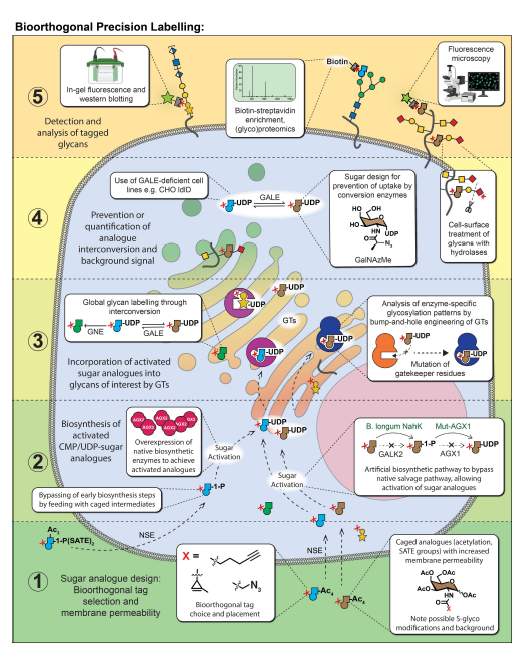
The ‘Design Rules’ consolidate the findings of several groups in a simple roadmap to make metabolic glycan labelling as effective as possible. From the MOE approaches developed over the years, it has become apparent that certain design rules should be followed to assure cellular glycan incorporation and prevent unwanted side reactions:

  • Choice of an appropriate monosaccharide:
  • Confirmation of a biosynthetic pathway:
  • Caging groups
  • Derivatisation:
  • Quality control:
  • Consideration of glycan elaboration
EFigure: Experimental design rules for MOE. For efficient labelling of glycans, the appropriate sugar analogue must be selected with consideration for the intended target glycans and the method of analysis. Biosynthesis of the appropriate activated sugar analogue by the relevant enzymes can be achieved through various methods and must then be verified. Following this, GTs of interest should be able to accept the activated sugar analogues, either in their WT state or through BH engineering. Background labelling and interconversion must be considered in the experimental design by either preventing certain forms of interconversion altogether or by removing interconversion products before analysis. Finally, the appropriate analysis method can be employed to investigate glycosylation. GNE: UDP-GlcNAc-2-epimerase/ManNAc Kinase.

Latest news

A weakness in glycobiology research is the insufficient integration of approaches used to connect glycan...

Animals and plants use conceptually similar immune systems to detect microbes and activate defenses. In...

The article outlines the history, capabilities, and significance of Privateer, a specialized carbohydrate validation software...

A newly discovered small molecule anticoagulant called SB-01 represents a major advancement in developing safer,...