Cryo-EM: the revolution continues

Author(s)

S. Subramaniam, W. Kühlbrandt & R. Henderson

Sources

Cryo-EM: the revolution continues IUCrJ, 2026 13, 3066311

The near-universal adoption of electron cryo-microscopy (cryo-EM) by structural and cell biologists has led to exponential growth of the field, especially over the last two decades, with a doubling in the number of deposited electron-microscopy density maps every 2.5 years. This exponential growth has changed in recent years to become linear. Cryo-EM methods are now able to contribute to our structural understanding of biological complexity, ranging from atomic-resolution maps of assemblies of multiprotein complexes to in situ investigation of protein structures in the context of intact cells, snapshots of multiple conformations, and insights into fundamental chemical mechanisms underlying biological function. Combined with dramatic advances in artificial intelligence, the increasing democratization and implementation of cryo-EM appears poised to drive a new revolution in digital biology.
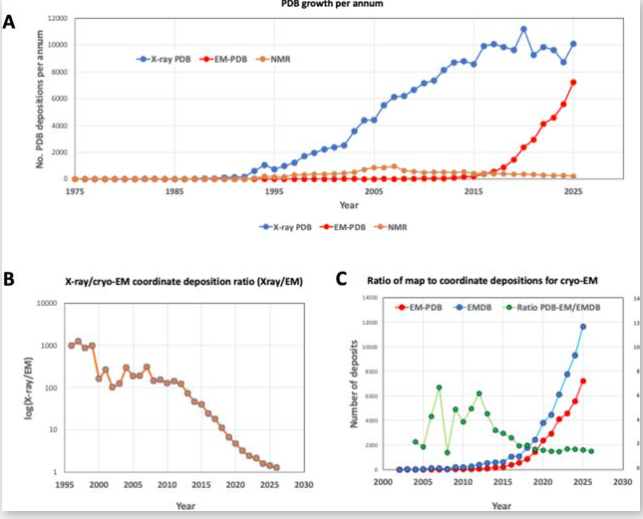
Plot of the number of depositions in the EMDB and the PDB over the last 50 years. (A) Annual growth in PDB structures from X-ray crystallography (blue), cryo-EM (red) and NMR (brown). (B) Change in ratio of depositions from X-ray crystallography and cryo-EM over time. (C) Growth in the number of depositions of cryo-EM maps (blue) and cryo-EM-derived PDB coordinates (red), and the change in the ratio (green) over time. For (C), the right axis represents the ratio. The data are derived from information available at the EMDB (https://www.ebi.ac.uk/emdb).

Latest news

This study uncovers a surprising, non-linear behavior in how polysaccharides change shape when you add...

Isotopic metabolomics reveals that plant species exhibit highly divergent carbon allocation and metabolic rewiring strategies...

The Protein Data Bank (PDB), established in 1971, is the primary global, open-access archive for...

Carbohydrates are among the most abundant and structurally diverse biomolecules in nature, playing central roles...