
Water confined within low-dimensional materials exhibits structural and dynamical behaviors that fundamentally differ from those of bulk liquid water. Nanoscale confinement reshapes the hydrogen-bond network, induces molecular ordering, and alters dielectric, vibrational, and transport properties through the interplay of geometry, surface chemistry, and electrostatics.
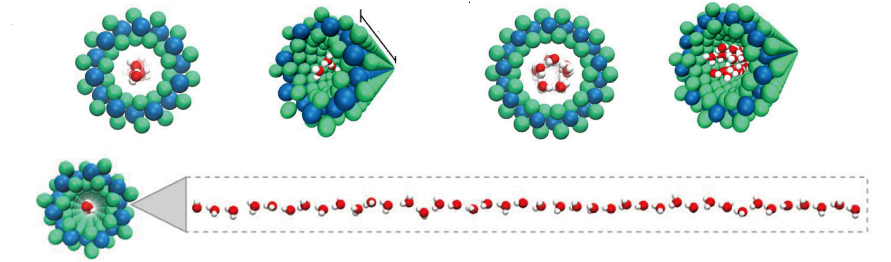
This review offers a comparative synthesis of confined water across 0D–2D environments, spanning single-molecule encapsulation in molecular cages, single-file flow in carbon nanotubes, and layered phases trapped between atomically flat van der Waals crystals. The author outlines how dimensionality and surface polarity govern hydrogen-bond rearrangement, layering, and crystallization into low-dimensional ice polymorphs.
Spectroscopically, Raman, infrared, terahertz, and nonlinear optical probes reveal distinct vibrational fingerprints that reflect changes in hydrogen-bond strength, dipole alignment, and collective dynamics. In the transport regime, continuum hydrodynamics breaks down, giving rise to superlubric flow, anisotropic diffusion, and quantized single-file motion.
Across these systems, confinement transforms water from a fluctuating three-dimensional liquid into a tunable, ordered medium that bridges molecular and solid-state physics. By unifying results from structural, spectroscopic, and transport studies, this review provides a coherent physical framework for understanding confined water in low-dimensional materials and highlights its implications for nanofluidics, energy storage, and bio-inspired systems.