
Lipopolysaccharides (LPSs) from Gram-negative bacteria have long been regarded as prototypical “endotoxins” that activate the immune system and provoke inflammation. This simplified view is increasingly challenged by evidence from gut commensals. The gastrointestinal tract is the body’s largest reservoir of LPS, reflecting the dense Gram-negative microbiota of the small and large intestine, with total LPS mass in healthy individuals estimated to exceed 1 g. The ubiquity of LPSs in this context makes it clear that their presence alone cannot account for inflammatory responses. Instead, chronic exposure to structurally diverse, often low-potency or atypical LPSs can reshape innate immune signaling—either by promoting tolerance or by providing insufficient tonic stimulation, thereby increasing susceptibility to dysregulated activation. Elucidating the structural and cellular mechanisms that maintain this immunological balance is therefore essential for understanding the role of gut-derived LPSs in health and disease.
In this Perspective, the authors highlight recent advances that uncover the remarkable chemical diversity of commensal LPSs and demonstrate how subtle variations in lipid A acylation and phosphorylation, core oligosaccharide architecture, O-antigen composition, and higher-order supramolecular organization profoundly alter receptor engagement and downstream immune responses. These findings reveal the vast, and still largely unexplored, potential of gut LPS chemistry to define structural principles distinguishing inflammatory, tolerogenic, and immunologically “tuned” states. While elements of this framework are beginning to emerge, a cohesive conceptual model is still lacking. Deciphering the chemical language of gut LPSs will be crucial not only to move beyond their classification as inherently pathogenic molecules, but also to harness them as sources of immunomodulatory cues and as blueprints for next-generation strategies to precisely control host–microbe interactions.
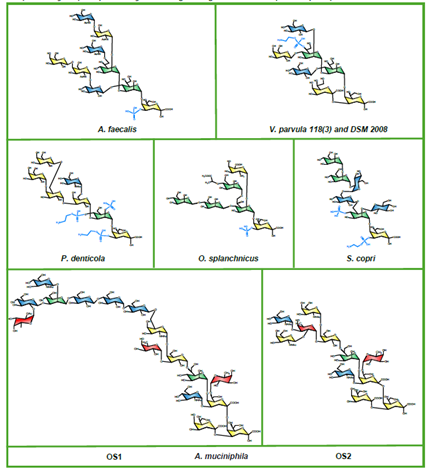
Core OS structures from gut commensals. Colors follow the Symbol Nomenclature for Glycans to enable rapid identification of sugar configurations: green for manno-, blue for gluco-, and yellow for galacto-configured sugar units. Kdo is depicted in yellow, while fucose residues are shown in red, in accordance with SNFG conventions