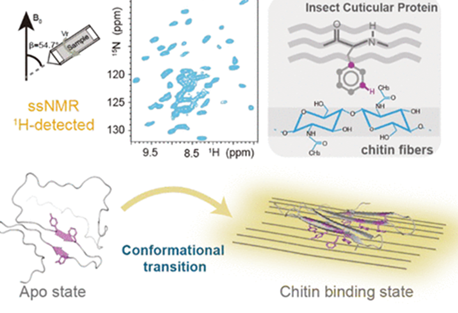

The insect exoskeleton exemplifies how nature employs organic materials to produce high-performance substances characterized by durability, tensile strength, and lightness. Studying the atomic structure of these multifunctional organics, primarily proteins and chitin, in insect cuticles helps reveal this secret. However, understanding how cuticular proteins interact with chitin polysaccharides in complex systems remains challenging.
Nuclear magnetic resonance (NMR) spectroscopy, which provides atomic-level insights, can identify distance relationships and local structures without needing long-range order. In this research, the authors examined the main components of insect cuticles—cuticular proteins and chitin polysaccharides—using both solution and solid-state NMR techniques. The results show that larval cuticle proteins of Ostrinia furnacalis, specifically OfLCP30-C, are naturally disordered in water but assume a folded structure when binding to chitin polysaccharides. High-resolution 1H-detected solid-state NMR spectra allowed the determination of the atomic structure of OfLCP30-C in its chitin-bound form. Aromatic amino acids positioned on the same side of the planar structure act as sticky patches, attaching to the chitin surface and playing a crucial role in the interaction. These findings provide a strong foundation for future studies on the extensive interactions between cuticular proteins and polysaccharides.