Efficient conversion of hemicellulose into high-value product and electric power by enzyme-engineered bacterial consortia

Author(s)

B. Liang, J. Yang, C-F. Meng, Y-R. Zhang, L. Wang, L. Zhang, J. Liu, Z.C. Li, S. Cosnier, A-H. Liu & J-M. Yan

Sources

Efficient conversion of hemicellulose into high-value product and electric power by enzyme-engineered bacterial consortia Nature Communications, 2024, 15:8764 https://doi.org/10.1038/s41467-024-53129-0

As an abundant agricultural and forestry biomass resource, hemicelluloses are hard to effectively degrade and utilize by microorganisms due to the constraints of membrane and metabolic regulations. The authors report a synthetic extracellular metabolic pathway with hemicellulose-degrading enzymes controllably displayed on Escherichia coli surface as engineered bacterial consortia members for efficiently utilising xylan, the most abundant component in hemicellulose. Further, they develop a hemicellulose/O2 microbial fuel cell (MFC) configuring of enzyme-engineered bacterial consortia-based ioanode and bacterial-displayed laccase-based biocathode. The optimized MFC exhibited an open-circuit voltage of 0.71 V and a maximum power density (Pmax) of 174.33±4.56μWcm−2. Meanwhile, 46.6% (w/w) α-ketoglutarate was produced in this hemicellulose fed-MFC. Besides, the MFC retained over 95% of the Pmax during 6 days’ operation. Therefore, this work establishes an effective and sustainable one-pot process for catalyzing renewable biomass into high-value products and electricity in an environmentally-friendly way.
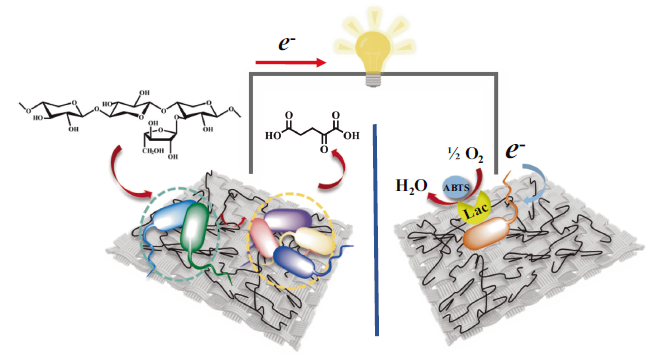
Schematic drawing of electron transfer route and catalytic reactions in the proposed two-compartment xylan/O2 MFC. The system was composed of the enzyme-engineered bacterial consortia-based bioanode and E. coli-Lac-based biocathode

Latest news

This study uncovers a surprising, non-linear behavior in how polysaccharides change shape when you add...

Isotopic metabolomics reveals that plant species exhibit highly divergent carbon allocation and metabolic rewiring strategies...

The Protein Data Bank (PDB), established in 1971, is the primary global, open-access archive for...

Carbohydrates are among the most abundant and structurally diverse biomolecules in nature, playing central roles...