
Growth, development, structure, and dynamic adaptations and remodelling processes in plants are largely controlled by the properties of their cell walls. These intricate wall structures are mostly made up of different sugars connected through specific glycosidic linkages and contain many glycosylated proteins. An essential plant sugar present throughout the Plantae, even before the divergence of the land plant lineage, but does not occur in animals, is L-Arabinose (L-Ara).
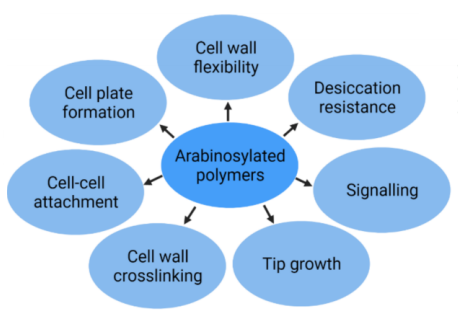
The article summarizes and discusses the processes and proteins involved in L-Ara de novo synthesis, L-Ara interconversion, and the assembly and recycling of L-Ara-containing cell wall polymers and proteins. The authors discuss the biological function of L-Ara in a context-focused manner, mainly addressing cell wall-related functions that are conferred by the basic physical properties of arabinose containing polymers/compounds. The authors explore these processes to direct future research efforts to the many exciting yet unanswered questions in this research area.
A. Mariette, H.S. Kang, J.L Heazlewood, S. Persson, B. Ebert, E.R Lampugnani
Plant and Cell Physiology, pcab087, https://doi.org/10.1093/pcp/pcab087