
Hierarchical carbohydrate architectures serve multiple roles in Nature. Hardly any correlations between the carbohydrate chemical structures and the material properties are available due to the lack of standards and suitable analytic techniques. Therefore, designer carbohydrate materials remain highly unexplored, as compared to peptides and nucleic acids. Here, a synthetic D-glucose disaccharide, DD, is chosen as a model to explore carbohydrate materials. Microcrystal electron diffraction (MicroED), optimized for oligosaccharides, revealed that DD assemble into highly crystalline left-handed helical fibres.
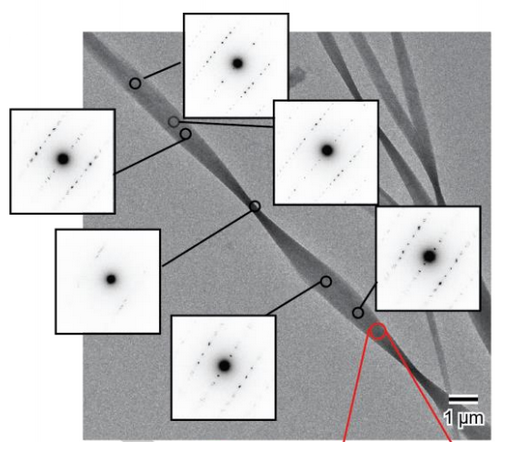
The supramolecular architecture was correlated to the local crystal organization, allowing for the design of the enantiomeric right-handed fibres, based on the L-glucose disaccharide, LL, or flat lamellas, based on the racemic mixture.
Tunable morphologies and mechanical properties suggest the potential of carbohydrate materials for nanotechnology applications. In addition to crystallographic information, From the standpoint of methodological developments, the work described in the article is one of the first example showing how MicroED not only can help solving 3-D structures of carbohydrates but also provide structural insight into larger-scale supramolecular structures, such as a twist.