MOE: Metabolic Oligosaccharide Engineering
As one of the most abundant and diverse post-translational modifications in biology, glycosylation has a significant influence on the functions of proteins in health and disease. To untangle the complexity of glycan biosynthetic pathways, the process of studying glycosylation has been expedited by specialised, chemical labelling techniques. In the present review,the authors explore the development of metabolic glycan labelling from early biochemical methods to current approaches that use interdisciplinary techniques.
The authors highlight work that has informed the understanding of glycan biosynthesis through pioneering chemical biology approaches. The authors provide guidance for experimental design that can be tailored to the specific needs of those investigating glycosylation in the context of their own work.
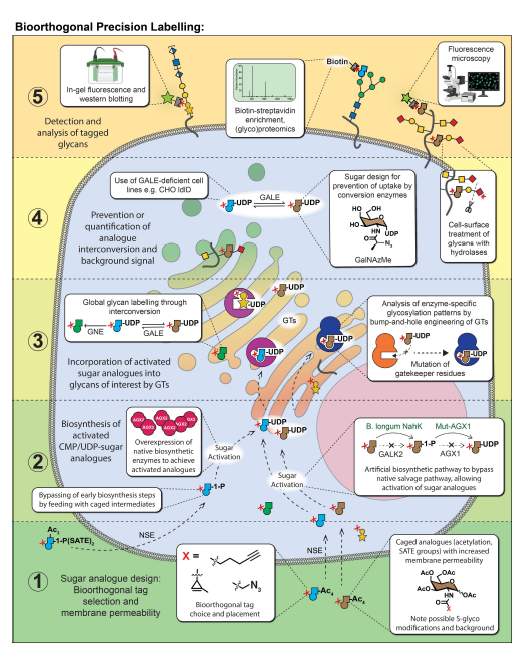
The ‘Design Rules’ consolidate the findings of several groups in a simple roadmap to make metabolic glycan labelling as effective as possible. From the MOE approaches developed over the years, it has become apparent that certain design rules should be followed to assure cellular glycan incorporation and prevent unwanted side reactions:
- Choice of an appropriate monosaccharide:
- Confirmation of a biosynthetic pathway:
- Caging groups
- Derivatisation:
- Quality control:
- Consideration of glycan elaboration