Detection of a four-carbon sugar (erythrulose) in interstellar space

Author(s)

I. Jiménez-Serra, J. García de la Concepción, H. M. Cuppen, M. Rey-Montejo, M. Sanz-Novo, V. M. Rivilla, J. Martín-Pintado, A. Megías, C. Briones, D. San Andrés, L. Colzi, S. Zeng, S. Martín, J. Salaris, A. Martínez-Henares, A. López-Gallifa, M. A. Requena-Torres, B. Tercero, P. de Vicente, A. Insausti,E. R. Alonso & E. J. Cocinero

Sources

Detection of a four-carbon sugar in interstellar space. Nat Astron (2026). https://doi.org/10.1038/s41550-026-02905-7

Sugars are essential biomolecules, serving as metabolic fuels, components of nucleic acid backbones, and structural or energy-storage polymers. A central question in origin-of-life research is how monosaccharides formed on the primitive Earth, as laboratory experiments under prebiotic conditions yield insufficient concentrations. The detection of ribose, glucose, and other monosaccharides in asteroids and meteorites suggests an exogenous origin, possibly in the interstellar medium (ISM) before meteoritic parent-body formation. However, no sugar has been observed in the ISM to date. Here the authors report the discovery of erythrulose, a chiral four-carbon ketose. Erythrulose, with 14 atoms in its structure, represents the largest non-cyclic molecular species identified so far. The detection was achieved through ultrasensitive, broadband spectral surveys of the Galactic Center molecular cloud G+0.693−0.027, using the Yebes 40 m and IRAM 30 m telescopes. Erythrulose appears to be at least eight times more abundant than analogous three-carbon sugars, which remain undetected in our ultrasensitive observations. Quantum chemical and astrochemical models indicate that erythrulose forms efficiently on interstellar dust grains from simpler two-carbon aldehydes and alcohols. As ketoses readily isomerize into aldoses under aqueous conditions, interstellar erythrulose could have contributed to the sugar inventory available for early metabolic and replication processes.
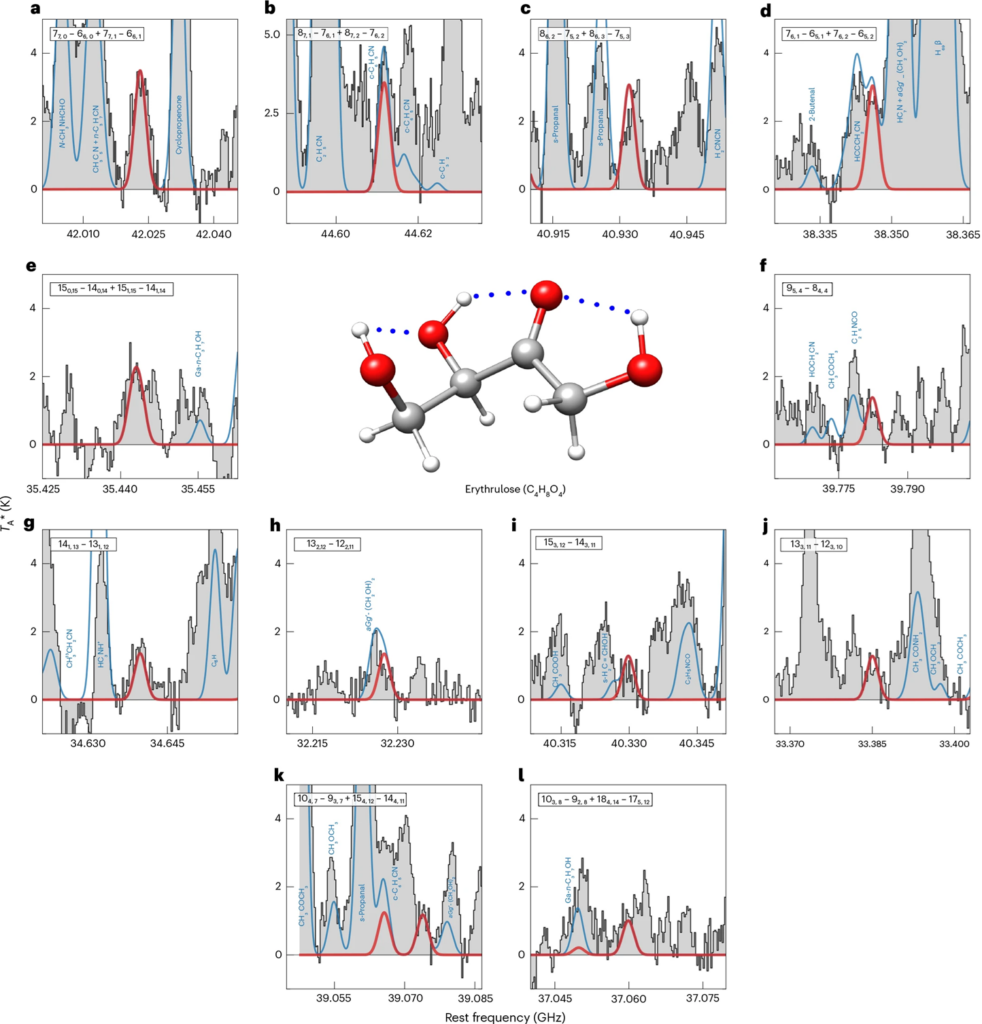
Filled histograms report the observed spectra; red lines show the line profiles of the erythrulose transitions fitted with MADCUBA-SLIM, and blue lines present the total fit to the spectra considering all the molecules identified towards the cloud. The intensity of the observed spectra is shown in units of antenna temperature, TA*. The quantum numbers of each transition of erythrulose are given in the upper part of each graph. Blue labels indicate the molecular species contributing to the observed spectra in the vicinity of the erythrulose lines. The transitions are sorted from the brightest to the weakest lines according to the LTE model.

Latest news

The near-universal adoption of electron cryo-microscopy (cryo-EM) by structural and cell biologists has led to...

This book examines the role of polysaccharides as essential biopolymers, tracing their origins, structural organization,...

Lipopolysaccharides are important components of the Gram-negative bacterial cell envelope that are involved in immune...

Using GAG microarrays, the authors profiled the binding specificity of 49 human lectins, including SIGLECs,...