Writers and Readers of Sialylation in Immunoregulation in Cancer

Author(s)

M. Decloquement & M.S. Macauley Decloquement M, Macauley MS, Writers and Readers of Sialylation in Immunoregulation in Cancer, Journal of Biological Chemistry (2026), doi: https://doi.org/10.1016/ j.jbc.2026.111249.

Sources

Decloquement M, Macauley MS, Writers and Readers of Sialylation in Immunoregulation in Cancer, Journal of Biological Chemistry (2026), doi: https://doi.org/10.1016/j.jbc.2026.111249.

Sialic acids are the terminal monosaccharides of the glycocalyx that play a crucial role in shaping cell-cell interactions. They are strongly involved in regulating immune recognition and tissue homeostasis. In cancer, abnormal sialylation rewires the tumor microenvironment by increasing ligands for inhibitory Siglecs, suppressing immune effector functions, and aiding metastatic spread. This review offers a comprehensive overview of the dual role of sialyltransferases (the “writers”) and Siglecs/Selectins (the “readers”) in cancer progression. The authors explore the structural and functional diversity of these molecules, their dysregulation in malignancy, and their effects on tumor–immune interactions. Finally, emerging therapeutic strategies are discussed, including sialyltransferase inhibitors, sialidase conjugates, and Siglec-targeted immunotherapies, which together highlight the sialome as a promising target in cancer treatment.
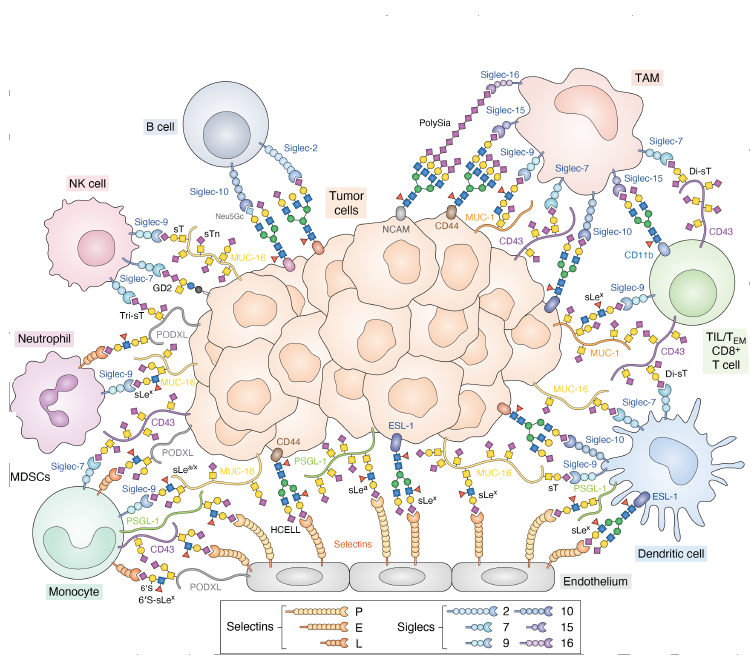
Landscape of Siglecs and Selectins interactions known with their sialylated ligands in the tumor cell microenvironment of cancer. Schematic representation of known interactions between tumor cell–associated sialoglycans and their cognate  receptors on immune and endothelial cells. Siglec–sialoside recognition mediates immune suppression, whereas Selectin–ligand binding (sLex, sLea) facilitates tumor cell adhesion, rolling, and metastasis within the vasculature.

Latest news

 GLYCAM Bacterial Carbohydrate Builder: a web-tool for modelling 3D structures of bacterial glycans The authors...

Glycosphingolipids are among the most structurally complex lipids in mammalian membranes. Comprising a ceramide backbone...

Sugar porters belonging to the major facilitator superfamily (MFS) represent one of the largest groups...

Asparagine-linked glycans are essential for the maturation and function of most eukaryotic secretory proteins. The...