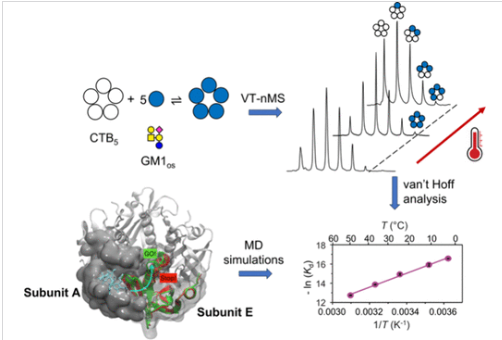

Cooperative ligand binding is a key determinant of specificity and regulation in biomolecular complexes. Yet its prevalence and mechanistic basis in glycan-binding proteins (GBPs) remain unclear. Here, the authors present the first quantitative analysis of the temperature dependence of cooperative glycan binding. Variable-temperature native mass spectrometry (VT-nMS) resolves sequential ligand binding to either the five primary or the five secondary sites of the cholera toxin B subunit homo-pentamer (CTB5). Stepwise apparent affinities for the primary sites reveal positive cooperativity that increases with both ligand occupancy and temperature. Van’t Hoff analysis shows that this temperature-enhanced cooperativity is predominantly entropy-driven. Mechanistic insight from temperature replica exchange molecular dynamics simulations shows that ligand binding at one primary site restrains a loop on an adjacent subunit (counterclockwise), widening its binding site. This pre-structuring progressively lowers the unfavorable conformational entropy penalty of binding, independent of the order of subunit occupancy. In contrast, sequential ligand binding at the secondary sites exhibits negligible cooperativity except at the highest temperatures, although the enthalpic and entropic contributions are comparable in magnitude to those for primary-site binding, suggesting a shared energetic framework. Together, these results provide detailed thermodynamic and structural insight into cooperative GBP–glycan interactions and establish an integrated VT-nMS and molecular dynamics framework for quantitatively probing cooperative ligand binding in complex biomolecular systems.