
This study uncovers a surprising, non-linear behavior in how polysaccharides change shape when you add a poorer cosolvent (like glycerol) to an aqueous (water-based) solution. In standard polymer physics (Flory-type mean-field theory), making a solvent progressively “poorer” is expected to cause a straightforward, continuous collapse of the polymer chain from a flexible coil into a compact blob.
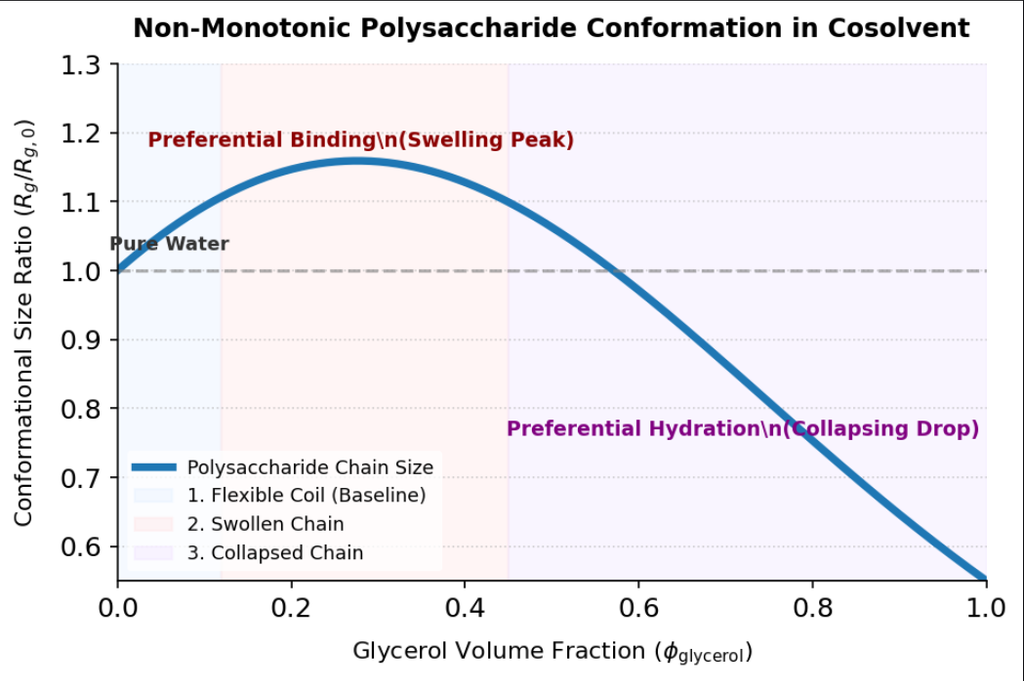
Instead, this study observes a three-step, non-monotonic transition: (1) Flexible Coil (In pure water). (2) Swollen Chain (At low glycerol concentrations) — This is the counterintuitive step. (3) Collapsed Chain (At high glycerol concentrations). The Underlying Mechanism: Preferential Solvation. The shape shifts are driven by how solvent molecules distribute themselves closely around the polysaccharide chain compared to the bulk solution, a concept explained via Kirkwood-Buff solution theory.
Low Glycerol Fraction (Initial Swelling): Contrary to the assumption that a poor cosolvent always repels the polymer, glycerol preferentially binds to the polysaccharide chain at low concentrations. This local crowding of glycerol molecules forces the chain to swell and expand. High Glycerol Fraction (Final Collapse): At higher concentrations, the system shifts to preferential hydration (water stays closer to the chain, while glycerol is excluded). Because the system wants to minimize the severe solvent entropic penalties of mixing, the polysaccharide chain collapses into a compact shape. Water Contact Conservation: Throughout these dramatic shape changes, the polysaccharide chains reconfigure specifically to conserve their total contact with water molecules. This is not an isolated anomaly. It represents a unified behavior seen across a wide variety of complex polysaccharides—including pectin, agar, alginate, carboxymethylcellulose, and dextran—whether they are linear or branched. Understanding this mechanism provides fundamental rules for how polysaccharides behave in biological systems and how they can be precisely manipulated in industrial applications