Structural basis for human chondroitin sulfate chain polymerization

Author(s)

P. Dutta, R.L. Cordeiro, M. Friedel-Arboleas, M. Bourgeais, S.D. Vallet , M. Weber, M. Molinas, H. Shu, M.N. N. Grønset, R.L. Miller ,.E.B. Erba & R. Wild

Sources

Structural basis for human chondroitin sulfate chain polymerization Nature Communications | ( 2025)1 6:11663 https://doi.org/10.1038/s41467-025-66787-5

Chondroitin sulfates are complex polysaccharides that regulate diverse biological processes at the cell surface and within the extracellular matrix. In this study, the authors identify four heterodimeric enzyme complexes that mediate chondroitin sulfate chain polymerization in humans: CHSY1–CHPF, CHSY1–CHPF2, CHSY3–CHPF, and CHSY3–CHPF2. Using a custom in vitro glycosylation assay using chemoenzymatically synthesized fluorescent substrates, the authors show that all four complexes can polymerize chondroitin sulfate chains. A cryo-electron microscopy structure of the CHSY3–CHPF complex reveals the molecular basis of the polymerization reaction. Structural analysis indicates that CHSY1 and CHSY3 harbor the catalytic activities, whereas CHPF and CHPF2 primarily serve a stabilizing function within the complexes. Mutational studies of purified complexes, together with in cellulo complementation assays, confirm that only CHSY1 and CHSY3 possess bifunctional glycosyltransferase activity. Finally, the spatial organization of the catalytic sites supports a non-processive, distributive mechanism for chondroitin sulfate chain polymerization.
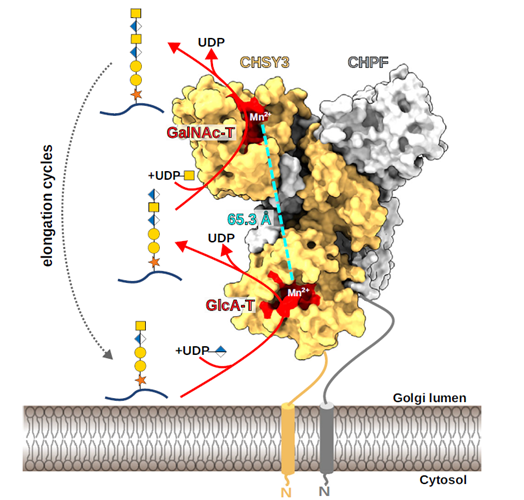
Molecular mechanism of CS chain polymerization. Illustration of the proposed mechanism for chain elongation by the CS polymerase complex CHSY3-CHPF. In a first reaction step, a GlcA residue is added onto the proteoglycan carrying a pentasaccharide-linker by the N-terminal GT domain of CHSY3. The generated hexasaccharide product is released and binds to the C-terminal GT domain of CHSY3, exhibiting GalNAc transferase activity. Upon GalNAc addition, the proteoglycan dissociates, and a new reaction cycle starts. Repetitive addition of GlcA and GalNAc residues leads to the generation of the long chondroitin sulfate backbone.

Latest news

Lipopolysaccharides (LPSs) from Gram-negative bacteria have long been regarded as prototypical “endotoxins” that activate the...

Milk oligosaccharides are vital for neonatal growth and health in mammals. However, most research on...

The insect exoskeleton exemplifies how nature employs organic materials to produce high-performance substances characterized by...

Plant and fungal cell walls play essential roles in growth, adaptation, and survival, with their...