Gold extraction at the molecular level using α- and β-cyclodextrins

Author(s)

S. Santos Braga

Sources

Beilstein J. Org. Chem. 2025, 21, 1116–1125.

Cyclodextrins (CDs) are known for their ability to form supramolecular interactions with a wide range of guest molecules. In this review, the focus is given on the inclusion of complex aurate ions such as tetrabromoaurate, dicyanoaurate, and a few other tetrahaloaurates. The review describes the properties of self-assembly of cyclodextrins with these ions, with a highlight to α-CD and, more recently, β-CD, requiring the use of a co-former/precipitating agent. Practical applications of this ability include the selective isolation of gold from a variety of sources, ranging from gold-rich mining ores and tailings/mining wastes to gold-bearing metal scraps obtained from discarded electronic devices. Moreover, it describes the development of a method based on the spontaneous complex formation between α-CD and tetrabromoaurate, as well as its current status of use in a few mining sites in the United States.
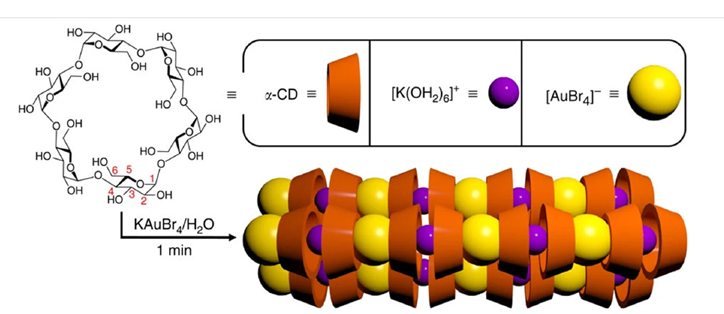
Figure: Schematic depiction of the α-CD channels containing the polyionic {[K(OH2)6]+[AuBr4]−}n chain inside. Reproduced from “Selective isolation of gold facilitated by second-sphere coordination with α-cyclodextrin © 2013 Z. Liu et al., published by Springer Nature, distributed under the terms of the Creative Commons Attribution-NonCommercial-NoDerivs 3.0 Unported License, ttp://creativecommons.org/licenses/by-nc-nd/3.0).This content is not subject to CC BY 4.0.

Latest news

This study uncovers a surprising, non-linear behavior in how polysaccharides change shape when you add...

Isotopic metabolomics reveals that plant species exhibit highly divergent carbon allocation and metabolic rewiring strategies...

The Protein Data Bank (PDB), established in 1971, is the primary global, open-access archive for...

Carbohydrates are among the most abundant and structurally diverse biomolecules in nature, playing central roles...