A library of N-glycan standards enables targeted glycomics

Author(s)

C. Ashwood and R.D Cummings

Sources

doi: https://doi.org/10.1101/2025.06.09.658590

Studies on glycans of glycoproteins are hampered by the lack of standards that reflect the wide diversity in structure typically observed. To this end the authors have exploited a large library of N-glycan standards comprised of a unique collection of 226 N-glycans including oligomannose, hybrid, and complex-type. Theygenerated a method employing porous graphitized carbon (PGC) and liquid chromatography mass spectrometry (PGC-LC-MS), which can provide a high degree of resolution of underivatized N-glycan structures. Chromatogram libraries arising from these studies include retention time data, diagnostic fragments, and validated structural assignments, providing a robust platform for both targeted and discovery-based glycomics. THe authors refer to this as an N-glycopedia, the first type of resource in which researchers can compare this collective data to N-glycans under study and overcome the limitations of only having compositional data and predicted structures. The technology is easily expandable to include additional N-glycans as new standards become available.
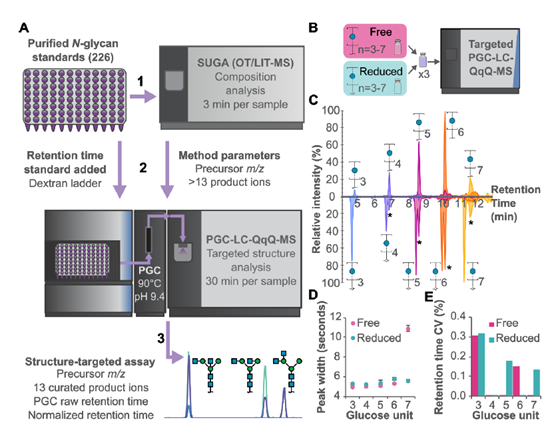
Figure. Advancements in non-reduced glycan analysis enable the development of a targeted N-glycan assay. (A) Data acquisition workflow for constructing an N-glycopedia of pure N-glycan structures. (B) Comparison of reduced and non-reduced glycans demonstrating equivalent performance by native PGC-LC-MS. (C) Reduced and non-reduced dextran ladder subunits produce equivalent chromatograms (* indicates isotopic interference from non-reduced dextran ladder). (D) Peak widths are consistent across dextran ladder formats, except for GU7. (E) RTs are consistent and equivalent between dextran ladder formats.

Latest news

This book examines the role of polysaccharides as essential biopolymers, tracing their origins, structural organization,...

Sugars are essential biomolecules, serving as metabolic fuels, components of nucleic acid backbones, and structural...

Cooperative ligand binding is a key determinant of specificity and regulation in biomolecular complexes. Yet...

The near-universal adoption of electron cryo-microscopy (cryo-EM) by structural and cell biologists has led to...