Visualization of Cellulose Structures with Cesium Labeling and Cryo-STEM

Author(s)

D. Knez, P. Petschacher, H. Wiltsche, J-L. Putaux, Y. Nishiyama, Y. Ogawa, G. Kothleitner, T. Nypelö and S. Spirk

Sources

Small 2025, 2500351, DOI: 10.1002/smll.202500351

Cellulose, a pivotal component of plant cell walls, is a widely studied biologically derived material with numerous potential applications. However, visualizing the arrangement of individual cellulose molecules within hierarchical structures with electron microscopy has proven challenging due to the material’s low contrast and high beam sensitivity. In this study, a novel approach is introduced that combines the labeling of cellulose functional groups with high-contrast cesium counter cations (Cs+) in conjunction with atomic-resolution scanning transmission electron microscopy (STEM) in annular dark-field (ADF) mode at cryogenic temperatures. This technique identifies individual sulfate groups attached to cellulose chains within cellulose nanocrystal hierarchies at Ångström resolution.   A systematic comparison of experimentally obtained interatomic Cs+ distances with simulations can potentially enable the localization of labeled functional groups at the macromolecular level. The method can potentially elucidate the arrangements of polymer chains in nanoscale soft materials.
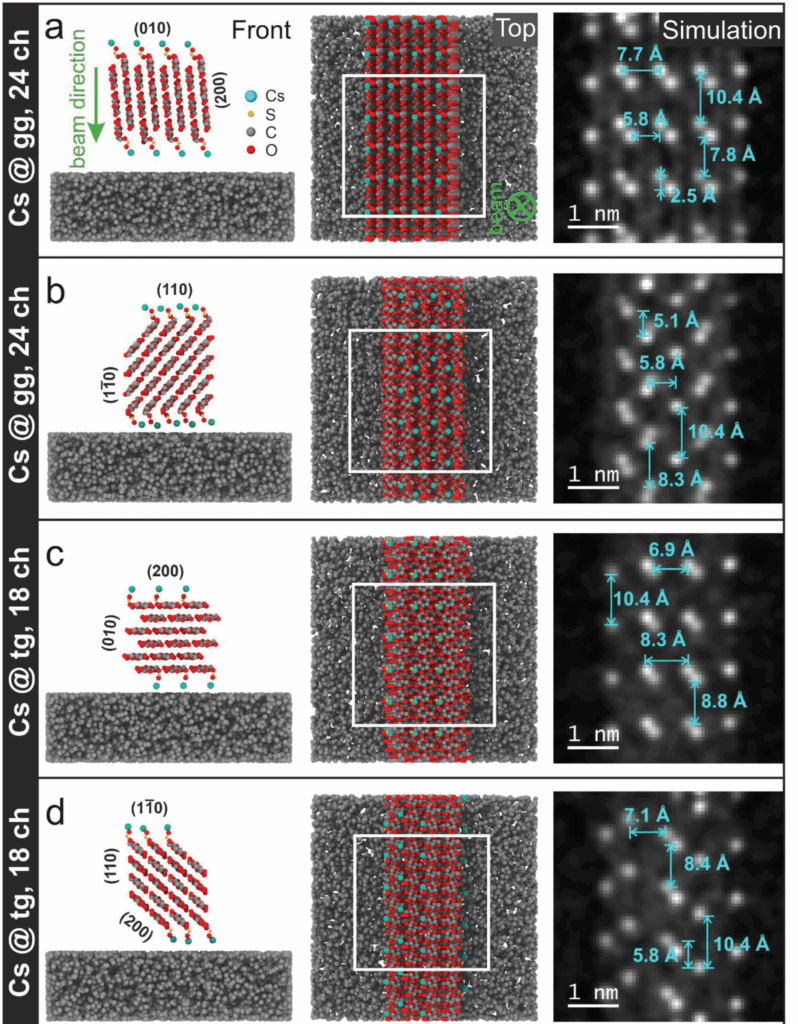
Modelling results based on 24 and 18 chain models with diamond-shaped a,b) and rectangular c,d) cross-sectional morphology, decorated with simplified sulfate groups at all surface C6 sites with gg conformation in (a,b) and C6 sites with the conformation in (c,d). For each geometry, the ball and stick model is given in front and top view, together with the multislice simulation result obtained from the area highlighted in the top view.

Latest news

This study uncovers a surprising, non-linear behavior in how polysaccharides change shape when you add...

Isotopic metabolomics reveals that plant species exhibit highly divergent carbon allocation and metabolic rewiring strategies...

The Protein Data Bank (PDB), established in 1971, is the primary global, open-access archive for...

Carbohydrates are among the most abundant and structurally diverse biomolecules in nature, playing central roles...