
Pseudomonas aeruginosa is a critical priority pathogen and causes life-threatening acute and biofilm-associated chronic infections. Choosing suitable treatment for complicated infections requires lengthy culturing for species identification from swabs or an invasive biopsy. No fast, pathogen-specific diagnostic tools for P. aeruginosa infections are available. Here, the authors present the noninvasive pathogen-specific detection of P. aeruginosa using novel fluorescent probes that target the bacterial biofilm-associated lectins LecA and LecB. Several glycomimetic probes were developed to target these extracellular lectins and demonstrated the ability to stain P. aeruginosa biofilms in vitro. Importantly, for the targeting of LecA an activity boost to low-nanomolar affinity could be achieved, which is essential for in vivo application. In vitro, the nanomolar divalent LecA-targeted imaging probe accumulated effectively in biofilms under flow conditions, independent of the fluorophore identity.
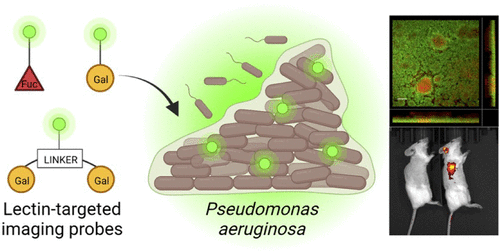
Investigation of these glycomimetic imaging probes in a murine lung infection model and fluorescence imaging revealed accumulation at the infection site. These findings demonstrate the use of LecA- and LecB-targeting probes for imaging P. aeruginosa infections and suggest their potential as pathogen-specific diagnostics to accelerate the start of the appropriate treatment.