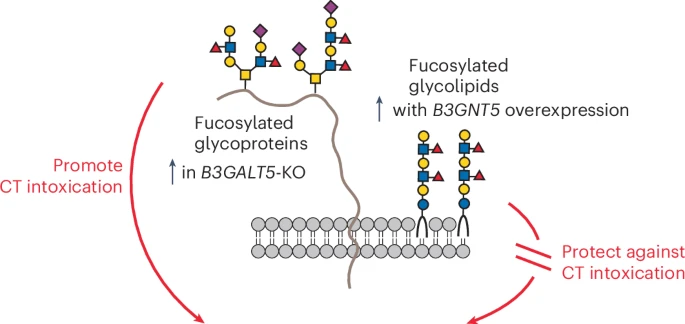

Cholera toxin (CT) is the etiological agent of cholera. The authors report that multiple classes of fucosylated glycoconjugates function in CT binding and intoxication of intestinal epithelial cells. In Colo205 cells, knockout (KO) of B3GNT5, which encodes an enzyme required for the synthesis of lacto and neolacto series glycosphingolipids (GSLs), reduces CT binding but sensitizes cells to intoxication. Overexpressing B3GNT5 to generate more fucosylated GSLs confers protection against intoxication, indicating that fucosylated GSLs act as decoy receptors for CT. KO of B3GALT5 causes increased production of fucosylated O-linked and N-linked glycoproteins , leading to increased CT binding and intoxication. KO of B3GNT5 in B3GALT5-KO cells eliminates the production of fucosylated GSLs but increases intoxication, identifying fucosylated glycoproteins as functional receptors for CT. These findings provide insight into the molecular determinants regulating CT sensitivity of host cells.