
The review highlights the recent high-resolution investigations of intact ECMs and native cells in many organisms spanning plants, bacteria, fungi, and algae.
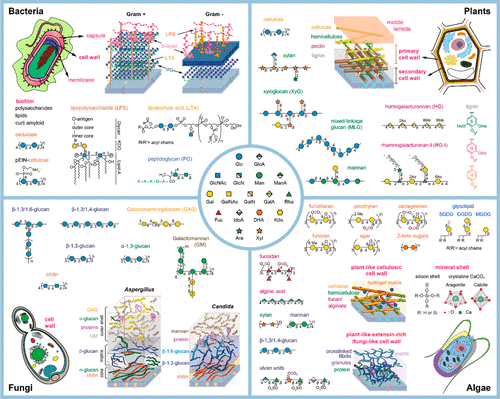
Extracellular matrixes (ECMs), such as the cell walls and biofilms, are essential for supporting cell integrity and function and regulating intercellular communication. These biomaterials are also of significant interest to the production of biofuels and the development of antimicrobial treatment. Solid-state nuclear magnetic resonance (ssNMR) and magic-angle spinning-dynamic nuclear polarization (MAS-DNP) are uniquely powerful for understanding the conformational structure, dynamical characteristics, and supramolecular assemblies of carbohydrates and other biomolecules in ECMs. The authors spotlight the structural principles identified in ECMs. They discuss the current technical limitation and underexplored biochemical topics. They point out the perspectives enabled by the recent advances of the rapidly evolving ssNMR technology.