
The Protein Data Bank (PDB), established in 1971, is the primary global, open-access archive for experimentally determined 3D macromolecular structures (proteins, RNA, DNA). The research-focused RCSB.org webportal provides access to these data alongside more than one million machine-learning-predicted structure models, greatly expanding the available structural landscape. Rapid growth of both experimental and computational structures has increased the need for powerful yet accessible search tools that serve a broad and diverse scientific community.
Unified Query Builder: Seamlessly combines annotation filters, sequence similarity search and 3D shape similarity into complex Boolean queries.
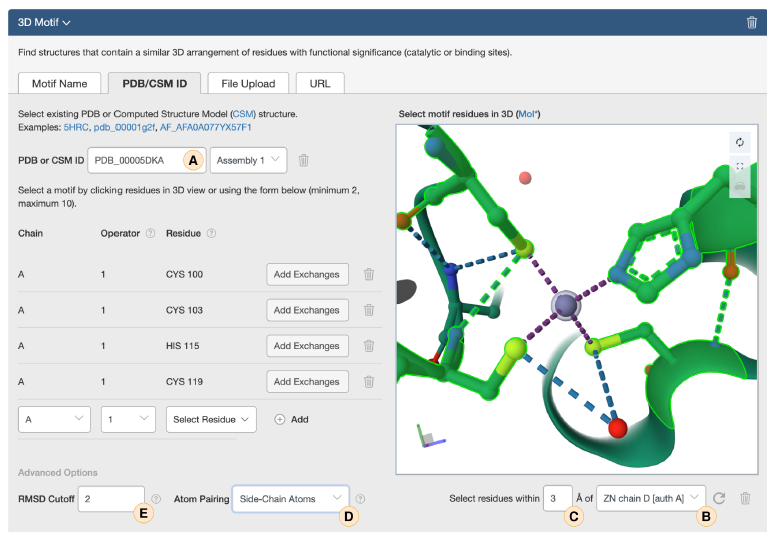
Integrated 3D Viewer: Features an embedded Mol* 3D tool inside the query builder, allowing you to define structural spatial parameters without needing formal nomenclature or residue numbers
Curated Biological Knowledge: Builds geometry-driven queries using active-site templates from the Mechanism and Catalytic Site Atlas (M-CSA) and ligand-guided structural motifs.
Advanced Chemical Search: Features an integrated chemical drawing tool to query small molecules via standard identifiers (SMILES, InChI, Chemical Formula), linked directly to structural annotations
Cross-Model Exploration: Allows users to query purely experimental data, include AI/ML models (AlphaFold DB and ModelArchive), or isolate Integrative/Hybrid Methods (IHM) structures.
The update significantly improves how results are refined, organized, and retrieved:
- Result Clustering: Results can be automatically grouped into UniProt Groups, Sequence Identity clusters, or Deposition Groups to map trends across related structures.
- MyPDB Integration: Users can authenticate via Google, Facebook, or ORCID to store search histories, re-run complex workflows, and subscribe to automatic email updates for weekly data releases.
- Programmatic Support: Advanced graphical queries built in the user interface can be exported into REST and GraphQL API queries via a dedicated interface