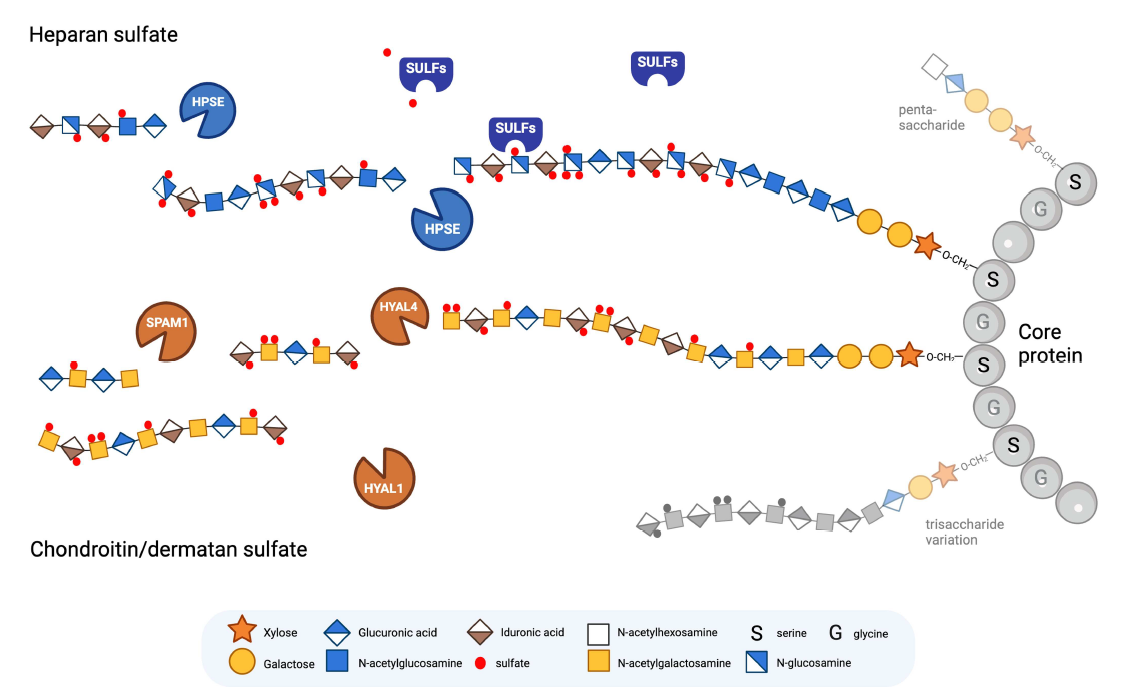

Pushing Frontiers for Proteoglycans” is a landmark scientific perspective article published in 2026 that details the massive structural heterogeneity, biomolecular breakthroughs, and clinical potential of the 73 known human proteoglycans. Led by researcher Marissa L. Maciej-Hume and collaborators, this publication outlines how recent advances in glycoproteomics are rescuing these complex glycoconjugates from being “underexploited” therapeutic targets. Proteoglycans consist of a core protein attached to heavily sulfated glycosaminoglycan (GAG) chains like heparan sulfate or chondroitin sulfate. Because they act as central hubs interacting with growth factors, chemokines, and structural matrix components, mastering their biology is unlocking a major new layer of cellular medicine. 78% of all human proteoglycans (57 out of 73) have been formally highlighted as potential prognostic biomarkers for at least one type of cancer. Proteoglycan analysis has historically been stymied because researchers had to strip the GAG chains away from the core protein. New mass spectrometry workflows allow scientists to profile complete, site-specific glycoforms from single tissue biopsies or biofluids without destroying the native architecture.
The “Pushing Frontiers” movement coincides with state-of-the-art chemical-genetic techniques designed to manipulate how these proteins behave in real time: The GlycoMAP Project: A sequential purification technique paired with mass spectrometry to map exact GAG, N-glycan, and O-glycan structures from a singular biological environment. Bump-and-Hole Engineering: Researchers are engineering specific glycosyltransferases (such as XT1, XT2, or N-acetylglucosaminyltransferase I) to transfer chemically tagged analogs (like 6AzGlc) directly to target proteins. “The approach allows pinpointing glycosylation sites by mass spectrometry and exploiting the chemical handle to manufacture proteoglycans with defined glycosaminoglycan chains…” Chemical Editing & Mimetics: Creating defined semi-synthetic, modular proteoglycans to isolate which structural regions drive actions like stem cell differentiation or cancer cell spreading. Historically overshadowed by easier-to-scale DNA and standard protein therapies, proteoglycans are seeing a massive resurgence in biomedical engineering.