Structural Basis of Lipopolysaccharide O-Antigen Chain Length Modality

Author(s)

B. Wiseman, G. Widmalm & M. Högbom

Sources

Structural Basis of Lipopolysaccharide O-Antigen Chain Length Modality. Research. 2026;9:1276.DOI:10.34133/research.1276

Lipopolysaccharides are important components of the Gram-negative bacterial cell envelope that are involved in immune evasion and act as a protective barrier. Using cryo-electron microscopy, the authors resolved the structure and dynamics of FepE, the co-polymerase component of the Wzy-dependent pathway responsible for length modulation of very long O-antigen molecules. Comparison of the interior volumes of related co-polymerases’ periplasmic domains with the volume of hydrated sugars suggests that the size of the periplasmic domain controls the length of the O-antigen, implying that polysaccharide chain polymerization occurs inside the co-polymerase periplasmic domain. Moreover, the authors show the opening of the FepE complex as well as other large mechanistically relevant movements. The opening of the complex presents an attractive corridor for the release of completed polysaccharide chains.
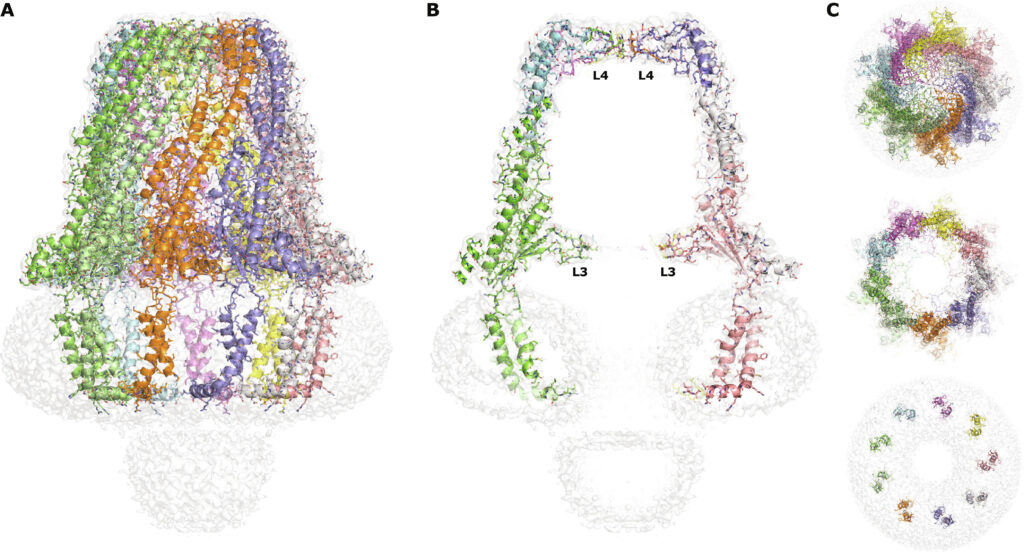
Overall structure of a closed nonameric Escherichia coli FepE complex. (A) Cartoon representation of the closed nonameric FepE complex overlaid with the C9-symmetrized FepE cryo-electron microscopy (cryo-EM) density map (white). (B) Sliced to display the interior of the complex. (C) Top view looking down from the periplasmic side. Top: view looking down from the top of the periplasmic domain. Middle: sliced to the level of the interior periplasmic L3 loop. Bottom: sliced to the level of the membrane to display the doughnut-shaped detergent micelle (white) and 9 transmembrane domains

Latest news

The near-universal adoption of electron cryo-microscopy (cryo-EM) by structural and cell biologists has led to...

This book examines the role of polysaccharides as essential biopolymers, tracing their origins, structural organization,...

Sugars are essential biomolecules, serving as metabolic fuels, components of nucleic acid backbones, and structural...

Using GAG microarrays, the authors profiled the binding specificity of 49 human lectins, including SIGLECs,...