A glycosaminoglycan microarray identifies galectin-4 binding to sulfated glycosaminoglycans

Author(s)

K. Sano, M. Nagatomo, K. Shigematsu, K. Yamasaki, D. X. Tuan Anh, A. Shibuya, Y. Otsuka, T. Minamisawa & H.Tateno

Sources

A glycosaminoglycan microarray identifies galectin-4 binding to sulfated glycosaminoglycans Biochemistry and Biophysics Reports, 2026, 47, 102689

Using GAG microarrays, the authors profiled the binding specificity of 49 human lectins, including SIGLECs, C-type lectins, and galectins. GAGs containing 6-O-sulfation, particularly heparin, chondroitin sulfate C, and chondroitin sulfate E, bound broadly to SIGLECs and C-type lectins, whereas weakly sulfated GAGs showed limited interactions. Most galectins did not bind GAGs, but galectin-4 displayed strong affinity for 6-O-sulfated GAGs, especially heparin (Kd = 4.70 × 10⁻⁸ M). Experimental and simulation data indicated cooperative involvement of both carbohydrate-recognition domains. Galectin-4 also bound heparin-positive mast cells, revealing a noncanonical sulfated-GAG recognition mechanism.
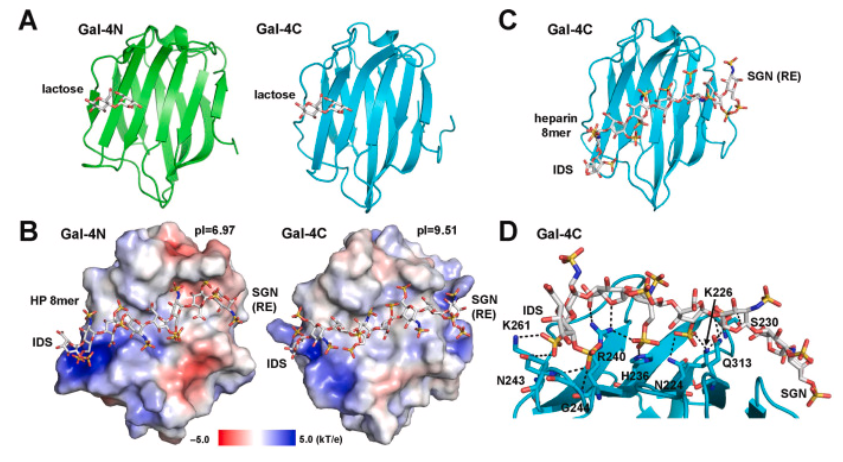
Molocular Dynamics -assisted modeling of the Gal-4–HP interaction. (A) Crystal structures of N- and C-terminal CRDs (Gal-4N and Gal-4C) binding lactose. (B) Electrostatic surfaces of CRDs (the left and right panels are for Gal-4N and Gal-4C, respectively) generated by the Adaptive Poisson-Boltzmann Solver (APBS) [31] used via PyMOL ver. 2.5 (Schrodinger, LLC). A HP octasaccharide (IDS[α1-4]SGN[α1-4]IDS[α1-4]SGN[α1-4]IDS[α1-4]SGN[α1-4]IDS[α1-4]SGN[α1]-OH derived from PDB entry 1HPN) was fitted into the groove that includes the lactose binding site, and used as the starting structure of the MD simulation. SGN: NO6-disulfo-glucosamine. IDS: O2-sulfoglucronic acid. R: reducing end. (C) The representative structure of the MD simulation for the HP bound to Gal-4C. (D) Intermolecular hydrogen bonds observed in the representative structure of the Gal-4C-HP complex (black dashed lines; donor-acceptor distance <3.5 Å).

Latest news

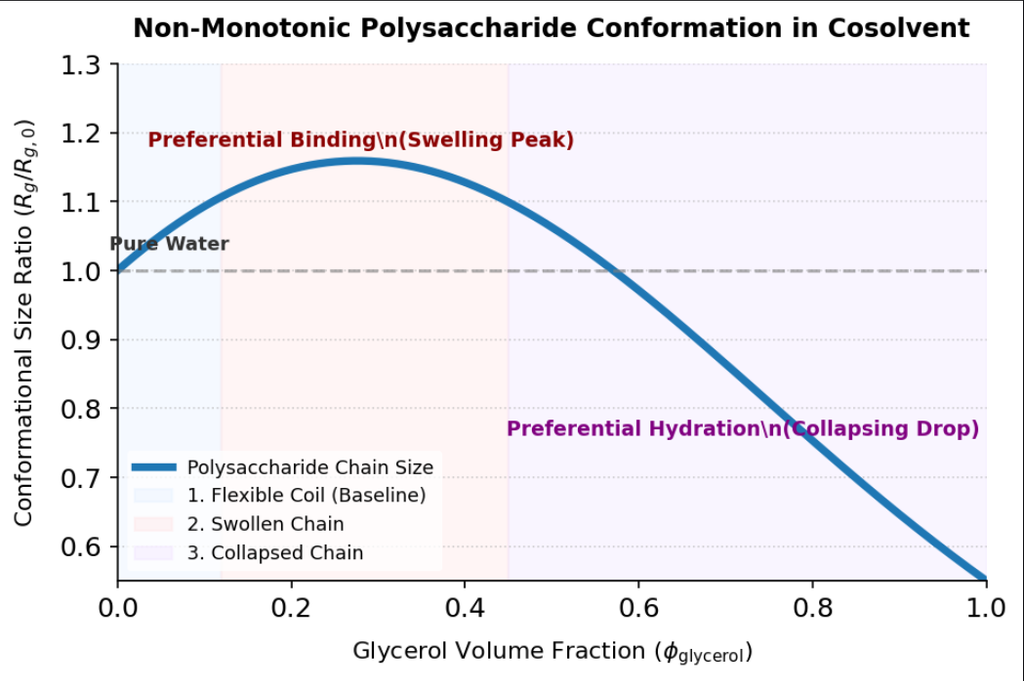
This study uncovers a surprising, non-linear behavior in how polysaccharides change shape when you add...

Isotopic metabolomics reveals that plant species exhibit highly divergent carbon allocation and metabolic rewiring strategies...

The Protein Data Bank (PDB), established in 1971, is the primary global, open-access archive for...

Carbohydrates are among the most abundant and structurally diverse biomolecules in nature, playing central roles...