GlycoMaple: recent updates and applications in visualization and  analysis of glycosylation pathways

Author(s)

Wei‑Ze Kong · Morihisa Fujita

Sources

Analytical and Bioanalytical Chemistry (2025) 417:885–894 https://doi.org/10.1007/s00216-024-05594-1

Post-translational modifications such as glycosylation, phosphorylation, and lipidation enhance protein diversity and function. Among these, glycosylation is one of the most prevalent modifications in mammalian cells. The process is tightly regulated at multiple levels, including transcription, translation, protein folding, intracellular transport, localization, and the activities of glycosyltransferases and glycoside hydrolases. It is also affected by the concentration of sugar nucleotides in the Golgi lumen. Unlike nucleic acid and protein synthesis, glycan biosynthesis does not rely on a template, which, combined with the structural complexity of glycans, creates an extremely intricate network. The authors previously developed GlycoMaple, a web-based tool that visualizes and estimates glycosylation pathways from gene expression data. GlycoMaple has been updated to incorporate additional genes and pathways. In this context, we introduce and explore the latest applications and enhancements of GlycoMaple.
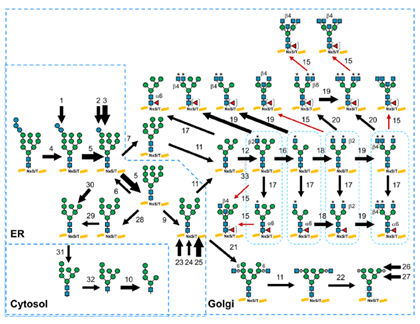
Visualization of the N-glycan processing pathway in HEK293 cells based on the gene expression profile. When users upload their own gene expression data or select data from cells or tissues in the Human Protein Atlas (HPA) database, the arrows for each reaction are updated based on the gene expression profiles. The thickness of the black arrows represents the expression levels of the genes required for the reactions. The red and pink arrows indicate that the expression of the genes involved in those reactions is either limited or absent, respectively.

Latest news

 GLYCAM Bacterial Carbohydrate Builder: a web-tool for modelling 3D structures of bacterial glycans The authors...

Glycosphingolipids are among the most structurally complex lipids in mammalian membranes. Comprising a ceramide backbone...

Sugar porters belonging to the major facilitator superfamily (MFS) represent one of the largest groups...

Asparagine-linked glycans are essential for the maturation and function of most eukaryotic secretory proteins. The...