
Deliveries of organic molecules from space, such as those found in carbonaceous meteorites, have long been hypothesized to have contributed to the inventory of the first life on Earth. This hypothesis is strengthened by detections of two of life’s fundamental building blocks—nucleobases and protein-building amino acids—in pristine samples returned by spacecraft from the carbonaceous asteroids Bennu and Ryugu. However, life also requires sugars, which cannot be searched for in Ryugu samples due to limited available mass, and their presence in some meteorites is equivocal owing to terrestrial exposure.
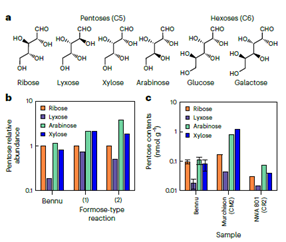
The authors analyse an extract from a sample of asteroid (101955) Bennu collected by the OSIRIS-REx spacecraft and identify several bio-essential sugars, including ribose (RNA sugar) and glucose (metabolism substrate). These sugars complete the inventory of ingredients crucial to life. Their distribution is consistent with that in the condensation products of formaldehyde solution. Given that Bennu contains formaldehyde and originates from an ancient parent asteroid that underwent long-term alteration by aqueous fluids, we postulate that the detected sugars formed in the parent asteroid from brines containing formaldehyde. This indicates that material with all three components necessary for life could have been dispersed to prebiotic Earth and other inner planets