
A code is defined by the nature of the symbols, which are used to generate information-storing combinations (e. g. oligo- and polymers). Like nucleic acids and proteins, oligo- and polysaccharides are ubiquitous, and they are a biochemical platform for establishing molecular messages. Of note, the letters of the sugar code system (third alphabet of life) excel in coding capacity by making an unsurpassed versatility for isomer (code word) formation possible by variability in anomery and linkage position of the glycosidic bond, ring size and branching. The enzymatic machinery for glycan biosynthesis (writers) realizes this enormous potential for building a large vocabulary. It includes possibilities for dynamic editing/erasing as known from nucleic acids and proteins. Matching the glycome diversity, a large panel of sugar receptors (lectins) has
developed based on more than a dozen folds. Lectins ‘read’ the glycan-encoded information. Hydrogen/coordination bonding and ionic pairing together with stacking and C-H/Pi-interactions, as well as modes of spatial glycan presentation, underlie the selectivity and specificity of glycan-lectin recognition.
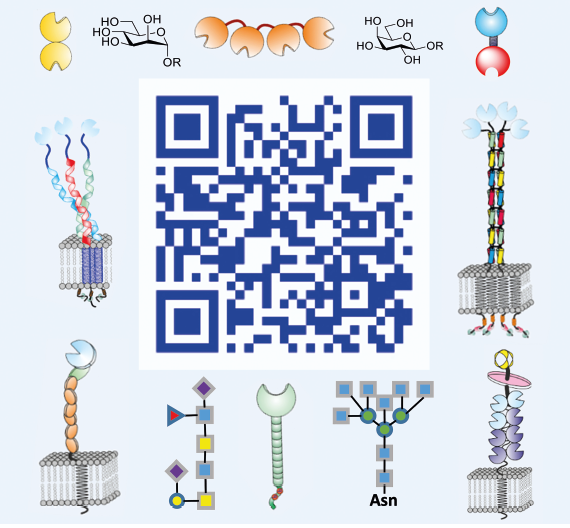
Modular design of lectins and glycan display and the nature of the cognate glycoconjugate account for many post-binding events. They give an entry to the glycan vocabulary its functional, often context-dependent meaning(s), hereby building the dictionary of the sugar code.
N.B. This article is dedicated to Prof. Samuel H. Barondes and to the memory of Prof. Dr. Hans-Joachim Gabius.